


 Red wine
 White wine
 Rosé wine
 Primeurs
 Sherry and Port wine
 Sweet wine
 Orange wine
 Vermouth
 Champagne
 Cava
Cava Prosecco
 Lambrusco
 Crémant
 Moscato d'Asti
 Franciacorta
 Pet-Nat
 Corpinnat
 Other sparkling wines
 Rhum
Rhum Gin
Gin Whisky
 Vodka
Vodka Cognac
 Brandy
 Pastis
 Tequila
 Mezcal
 Grappa and Eau de vie
 Calvados
 Liqueurs
 Pacharán
 Apéritifs
 Wine gift boxes
 Boxed wines
 Boxed sparkling wines
 Wine bottles and glasses
 Gift card
 Non alcoholic Wine
 Non alcoholic Sparkling wine
 Non alcoholic Gin
 Other non-alcoholic drinks
 Aromas
 Wine conservation
 Decanters and aerators
 Bottle identifiers
 Corkscrews
 Service
 Glass identifiers
 Cleaners
 Accessories set
 Wine glasses
 Contact

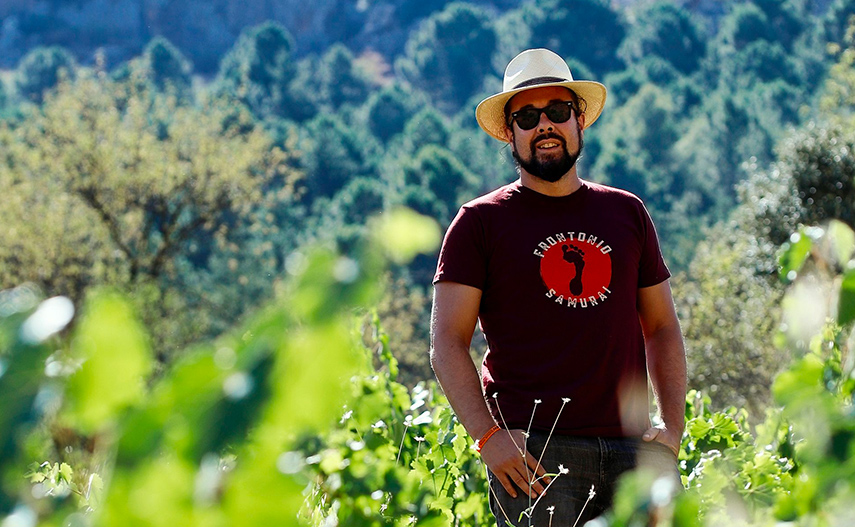
Fernando Mora MW and founder of Bodegas Frontonio
There are many kinds of love at first sight, but Fernando Mora's was straight from a movie. It all started with a wine tour and, from that very weekend, it was clear to him; he would leave everything to devote himself to the world of wine. And the truth is, he hasn’t done too badly at all, because in addition to creating his own winery, Frontonio, he has become a clear expert in grenache and the first Master of Wine (MW) in his region. A wine lover who has managed to turn a hobby into a real profession like no one else.
- As an engineer specialising in engines and renewable energies, what was it specifically that led you
to change profession overnight?
What made me change my profession was simply discovering that in the world of wine, it is not just technique that is important, but there are other more sensitive and artistic factors that come into play. And I always say that in the end, when it comes to the origin of a glass of wine, which is the countryside, we forget that wine is an agricultural product. And that's the beauty; to be able to reflect a site, a vintage, a specific place within a bottle of wine is a precious expression of winemaking.
- Although your family does not come from the world of wine, do you have any ties who have supported you with their advice or guidelines in your winemaking projects?
My parents are not from the world of wine, but they have always supported me in any adventures I take on in life, and have always focussed on giving me a good education and encouraging me to pursue my dreams.
I think this is something fundamental, even if it is not specifically related to wine. Additionally, another person who influenced me a lot was the person who taught me how to work; my first boss, Juan Jose Ortega. Later, in the world of wine, I have been able to visit, meet, work or help at many different wineries in different parts of the world, thus creating some of my ties in the world of wine.
Some of these people certainly include María José López de Heredia and her husband José Luis Ripa, friends who have supported me from the beginning. Ricard Rofes, from Scala Dei, was the one who really helped me to understand the love for the land and how to improve my grenache. Other people have influenced me a lot in other aspects of wine: Giuseppe Rinaldi changed my understanding of wine aging; Marcelo Retamal gave me the vision to harvest earlier; Derek Mossman, of Garage Wine, taught me to rethink things and how to really get into making a field blend; Álvaro Palacios, who has always trusted me right from the beginning, helped me a lot and gave me great advice. Also my friends at Comando G, Envínate, Roc Gramona, Javi Revert and many others who have always guided me and helped me so that, little by little, our wines, Mario's and mine, have been able to improve.
- Zaragozans have a reputation for being stubborn. In your case, it seems to suit you perfectly because, since you decided to change your life, you have stuck with it until you reached your goal. Is it true that you started making wine in the bathtub at home?
I always find it very amusing that out of all the things I've done, what people like the most is that I made wine in the bathtub at home. Actually, what happened is that I decided to start making wine when I lived in an apartment. So, the only place where I could do it was in one of the rooms there. So I set up a micro-winery with very limited resources inside one of the rooms. When fermentation temperatures were higher than I wanted, I put the small plastic tanks I was using in the bathtub, which I filled with water and ice, so that I could thermoregulate the fermentation. This then led to people saying I started making wine in the bathtub, and that's the origin of the legend.
- Saint Frontonio is the patron saint of Épila (Valdejalón) whose decapitated head was thrown into the Ebro and miraculously went upstream along the Ebro and Jalón rivers, until it reached Épila. Although it is true that your wines have a levitating effect, why did you decide to baptise the winery with the name of the town's saint?
To answer this question, I must first talk about another great person, Jesús Solanas, sommelier and painter, and my mentor in the early part of my winemaking career. He really taught me to understand what fine wine was and the union between art and culture, this being a very important element. When I gave him a taste of the first Frontonium, which at the time had no name, he was fascinated by what was inside that bottle. I remember telling him that I had no idea how much it might be worth, or what to call it. At that time we did not know for sure what our future in wine was. We wanted to give it a good send off by making the best wine we could. We imagined ourselves as the musicians on the Titanic who kept playing while the ship was sinking. And he really helped us to to find that historical link between the wine and the territory, but above all a history that was very much our own, in which we swim against the current. In a world where wines are becoming more and more industrial, we are going back to making things by hand, looking at everything that made sense in the past and using the knowledge we have today to seek a better future and thus achieve a great wine.
- You once said that you consider grenache to be the pinot noir of southern Europe. What is it about
grenache that can’t be found in any other variety?
For me, grenache is the variety of "the thousand faces of a diamond", i.e., it is very sensitive to the microenvironment in which it is located. Variations in altitude, soils and orientations change how grenache behaves, and what it expresses in its berry varies depending on its microenvironment. For this reason, when making grenache wines, there are significant differences between grenache wines from one specific site to ones from another. There are other varieties that I believe are less malleable and more rigid; I consider grenache to be a "terroir translator", a variety that is capable of showing very clearly where it comes from, and I think that's beautiful. I think pinot noir is a variety that also has points in common with this, being a very different variety to grenache. Grenache and pinot noir share certain characteristics: thin skin, and similarly fruity, floral and herbal profiles. But structurally speaking, they are different in terms of adaptability to climates, planting sites or sugar concentration.
- Microcósmico, Supersónico, Telescópico, Psicodélico... Although each one of your wines is different, all of them teleport you to a cosmic experience. What do you think the secret to your success is?
I find it very difficult to define success. I think that in relation to the Bodegas Frontonio project, our success lies in being able to produce the wines we are passionate about, by recovering vines that we are passionate about and sharing them with people we are passionate about. In the end, I think that's the key, that when you have a passion for something, the work becomes a pleasure and above all, gradually fulfils the dream of making a great wine. And above all, to be able to live with freedom.
- In addition to creating your own wines, you have become the first person from Aragon to receive the title of Master of Wine (MW), the highest distinction in the world of wine. Why did you decide to apply and what caused you the biggest headaches in successfully getting there?
In the end, becoming a Master of Wine was not on my radar until, for various reasons, I ended up going to a masterclass given in La Rioja. When I saw what it consisted of and the people that were involved, I became interested and decided I wanted to give it a try. There were many obstacles, the first one being my language barrier; the second one was a clear economic barrier. At the same time, I had been starting the Frontonio project and my financial resources were very tight; and the third one was assimilating all the necessary knowledge and practising enough to be able to really reach the level required. Those were my biggest obstacles. On the other hand, I think my greatest potential was the desire I had to learn and achieve the title and the power to orient my whole life to achieve this goal.
- With wines being produced in several wine-growing regions such as Valdejalón, Calatayud or Campo de Borja, do you see yourself trying your luck in another area with future possibilities? Will climate change lead you to propose new cultivation areas?
For me, Aragon is my home, it is the place where I was born, and making wines in the province of Zaragoza, in the Sierras del Jalón, more specifically in Alpartir (where I live), is my life. Recovering old grenache vineyards at mountain altitude and thus demonstrating that they can produce one of the best grenaches in the world is a vital objective that is difficult to achieve. Producing wine in other areas? I am tempted by the thought of making projects or creations with friends, because I believe that the beauty is learning and when you stop learning, life is boring. I really enjoy creating things with friends on other sites, it's about sharing, learning on both sides, and that's the beauty of it all, the power of sharing. Beyond that, I do not plan to make wines in other areas.
- An influencer both within and outside of the network, your Instagram live feeds have become a meeting point for professionals and amateurs in the sector. Do you think that social networks are helping to democratise the world of wine? Do you see any disadvantages in it?
I wouldn't technically consider myself an ‘influencer,’ I think that beyond the success of those chats we had, I didn't make them myself, but rather I and all the people who wanted to chip in made them, I think social networks are a nice tool when used properly. Social networks allow you to really bring the consumer, or the person who wants to drink wine, closer to being a ‘winelover’. And they also show what's behind a bottle of wine; all the work, all the different ways of making wine, the different philosophies of a producer, the different trends in viticulture.
They make a world that is undoubtedly opaque more transparent.
- Which person (living or dead) would you like to share a glass of your wine with? Which wine would you choose and why?
It's very complicated, because I think there are many people, living or dead, who I would want to share a glass of wine with. Why wouldn’t you want to share a glass of wine with interesting people? If I really had to choose someone, I would think of two people who have always fascinated me, Leonardo da Vinci, a person with an extraordinary artistic vision, with an extraordinary technical capacity, but, above all, with a unique ability to dream and invent. And I would add Maria Thun to that, a conscientious and precise woman whose experiments made sense of some questions about biodynamic agriculture and the creation of ‘her’ biodynamic calendar that her descendants continue today. I have always thought about the beauty of sharing a glass of wine with people who daydream and who dare to let the mind flow without any difficulty. I would open a bottle of El Jardín de las Iguales with both of them, probably the 2021 vintage, that has a lot to teach. It would be amazing to hear them debate, a pure fantasy.
- Finally, could you tell us about a new wine discovery that has been a real ‘love at first sight’ moment for you?
Things in wine are moving faster than ever and therefore, the truth is that almost every week I discover something I really like. If I had to choose, I'd go with what Arnot-Roberts is doing in the USA or what Timo Mayer is doing in Australia, both are looking for purity and precision in areas that were previously heavy and sweet. Arpepe is one of the wine projects that fascinates me the most, I know it is no discovery, but I try to keep as many bottles as I can, because soon, their wines will be impossible to get your hands on. And of course, in my house, I couldn't forget about Envínate, where you won’t make any great discoveries, but they are making more and more great wines that are undoubtedly at the peak of our country’s wines.